

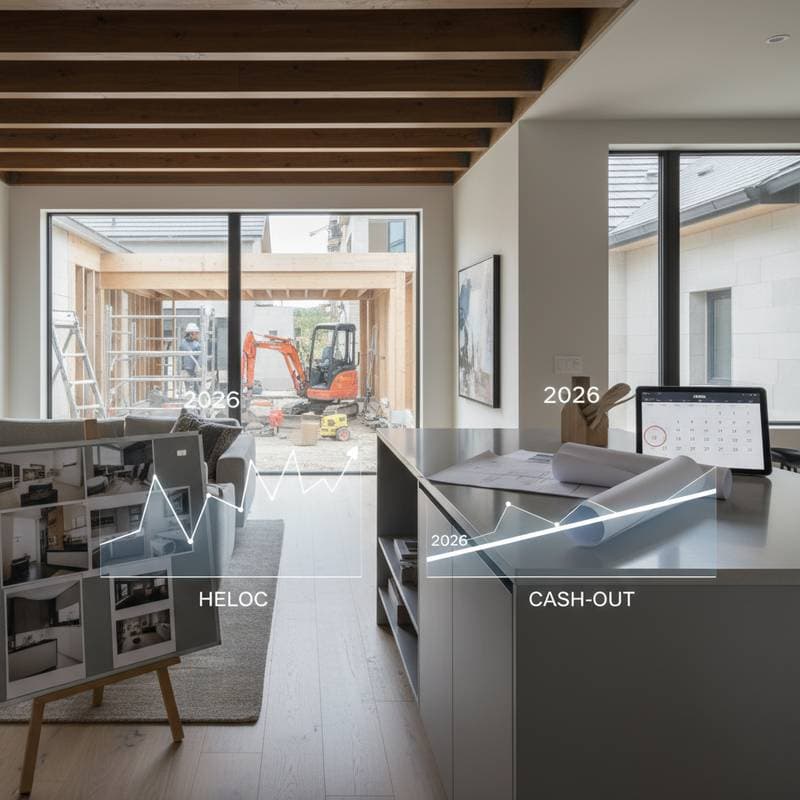
HELOC vs. Cash-Out Refinance: Ten Rules for Funding Your 2026 Remodel
Home remodeling projects blend creativity with practical constraints, and effective financing follows the same principle. Homeowners often face a choice between a Home Equity Line of Credit (HELOC) and a cash-out refinance to cover costs. A HELOC provides flexible, revolving access to funds, ideal for phased projects, while a cash-out refinance replaces your existing mortgage with a larger one, delivering a lump sum but potentially higher closing costs.
Rates for both options depend on factors like credit score, loan-to-value ratio, and market conditions projected for 2026. Understanding these elements ensures your financing supports the remodel without compromising long-term stability. The ten rules below link financial strategies to project execution, enabling decisions that enhance both your home and your finances.
1. Master the Basics of HELOC and Cash-Out Refinance
Problem: Homeowners often confuse the mechanics of these options, leading to mismatched expectations for fund access and repayment.
Context: You envision a full kitchen overhaul but select a financing method that limits draws during construction phases.
Solution: Opt for a HELOC if your remodel unfolds in stages, as it allows borrowing as needed up to an approved limit. Choose cash-out refinance for immediate, substantial funds when committing to a complete project upfront.
Technical detail: HELOCs typically feature a 10-year draw period with interest-only payments, followed by repayment. Cash-out refinances consolidate debt into one fixed-rate loan, often with terms of 15 to 30 years.
Benefit: Aligning the loan type with project timeline avoids delays and ensures funds match your build schedule.
2. Assess Your Home Equity Accurately
Problem: Overestimating available equity results in application denials or scaled-back plans.
Context: Your home has appreciated since purchase, yet outstanding mortgage balance and appraisal variances reduce borrowable amounts.
Solution: Obtain a professional appraisal or market analysis early. Lenders generally permit borrowing up to 80 to 85 percent of appraised value minus the existing loan balance.
Technical detail: For a $500,000 appraisal and $300,000 owed, equity at an 80 percent loan-to-value ratio yields $100,000 usable. This ratio influences rates, with lower ratios securing better terms.
Benefit: Precise equity evaluation sets realistic budgets and prevents mid-project funding gaps.
3. Compare Fees and Closing Costs Upfront
Problem: Hidden fees erode project budgets, turning a planned upgrade into an overextended expense.
Context: You secure approval but face unexpected origination, appraisal, and title fees that cut into material allocations.
Solution: Request a detailed fee breakdown from multiple lenders. HELOCs often involve lower upfront costs than cash-out refinances, which mimic full mortgage closings.
Technical detail: Expect 2 to 5 percent of the loan amount in refinance fees, versus 0 to 2 percent for HELOCs. Factor in potential annual fees for unused HELOC lines.
Benefit: Transparent cost analysis preserves funds for design elements and avoids financial surprises.
4. Anticipate Rate Fluctuations and Market Trends
Problem: Ignoring potential rate hikes disrupts payment affordability during extended remodels.
Context: Low rates at project start rise unexpectedly, inflating variable HELOC payments and straining cash flow.
Solution: Review economic forecasts for 2026 and weigh fixed-rate cash-out against variable HELOCs. Lock in rates via refinance if upward trends appear likely.
Technical detail: Cash-out options provide rate certainty, though initial rates may exceed HELOCs by 0.5 to 1 percent. Hybrid HELOCs offer fixed portions for critical draws.
Benefit: Proactive rate planning maintains budget integrity amid economic changes.
5. Evaluate Tax Implications and Deductibility
Problem: Failing to consider tax rules reduces net benefits from interest deductions.
Context: You finance a remodel but discover only certain uses qualify for deductions, affecting overall savings.
Solution: Confirm eligibility under current tax codes, where interest on home improvements remains deductible if itemizing. Consult a tax advisor for 2026 projections.
Technical detail: Deductions apply to loans secured by the home and used for buying, building, or substantially improving it, up to interest on $750,000 in debt.
Benefit: Maximizing deductions lowers effective costs, freeing resources for enhanced project features.
6. Preserve Equity for Future Needs
Problem: Exhausting equity in one project limits options for subsequent repairs or upgrades.
Context: A comprehensive cash-out for the remodel leaves no buffer for urgent issues like HVAC replacement.
Solution: Borrow conservatively, retaining 20 percent equity as a safety net. Utilize a HELOC for its reusable nature post-draw period.
Technical detail: Verify lender policies on HELOC renewals and minimum usage to avoid fees. Refinances reduce equity outright upon closing.
Benefit: Reserved equity supports ongoing home maintenance and evolving design aspirations.
7. Review Qualification Requirements Thoroughly
Problem: Inadequate credit or income documentation delays approvals and project starts.
Context: Strong equity exists, but a recent credit dip or variable income raises lender concerns.
Solution: Improve credit scores above 680 and gather proof of stable income before applying. Both options require similar underwriting, but refinances scrutinize debt-to-income ratios more closely.
Technical detail: Aim for debt-to-income under 43 percent. HELOCs may approve higher ratios due to their line-of-credit structure.
Benefit: Meeting qualifications streamlines the process, accelerating your remodel timeline.
8. Align Financing with Design and Construction Phases
Problem: Disconnecting funding from project plans causes budget overruns or feature eliminations.
Context: Designs finalize without loan confirmation, forcing reductions when funding falls short.
Solution: Secure pre-approval and incorporate lender limits into architect consultations. Build in 10 to 15 percent contingency funds.
Technical detail: Construction escrows release HELOC or refinance proceeds upon verified milestones, ensuring controlled spending.
Benefit: Synchronized planning delivers a unified outcome without disruptive adjustments.
9. Develop a Robust Repayment Strategy
Problem: Underestimating repayment demands leads to cash flow issues post-remodel.
Context: Large draws from a HELOC accumulate, and unexpected costs delay payoff plans.
Solution: Map payments against post-project income, prioritizing principal reduction during low-interest periods. Refinance into fixed terms for predictable obligations.
Technical detail: HELOC repayment phases often span 20 years with amortizing payments. Automate transfers to maintain discipline.
Benefit: Strategic repayment minimizes interest accrual and sustains financial well-being.
10. Monitor Long-Term Equity and Market Impact
Problem: Short-term focus overlooks how financing affects future home value and saleability.
Context: Increased debt from cash-out reduces net proceeds upon selling, despite remodel gains.
Solution: Track equity buildup through payments and appreciation. Choose options that preserve positive cash flow for resale.
Technical detail: HELOCs maintain original mortgage rates, potentially boosting equity faster than refinances that reset terms.
Benefit: Thoughtful monitoring enhances wealth building and positions your home for optimal future value.
Securing Your Remodel's Financial Foundation
Applying these rules transforms financing from a hurdle into a strategic asset. By selecting between HELOC and cash-out refinance based on your 2026 project's scope, you protect investments and amplify home value. This approach ensures your remodel not only beautifies your space but also strengthens your financial position for years ahead.